Preparing a stucco or brick front for repainting in the Hampstead conservation area
How to prepare stucco and brick for repainting in Hampstead, where most Downshire Hill houses are stuccoed and original brick stays unpainted.
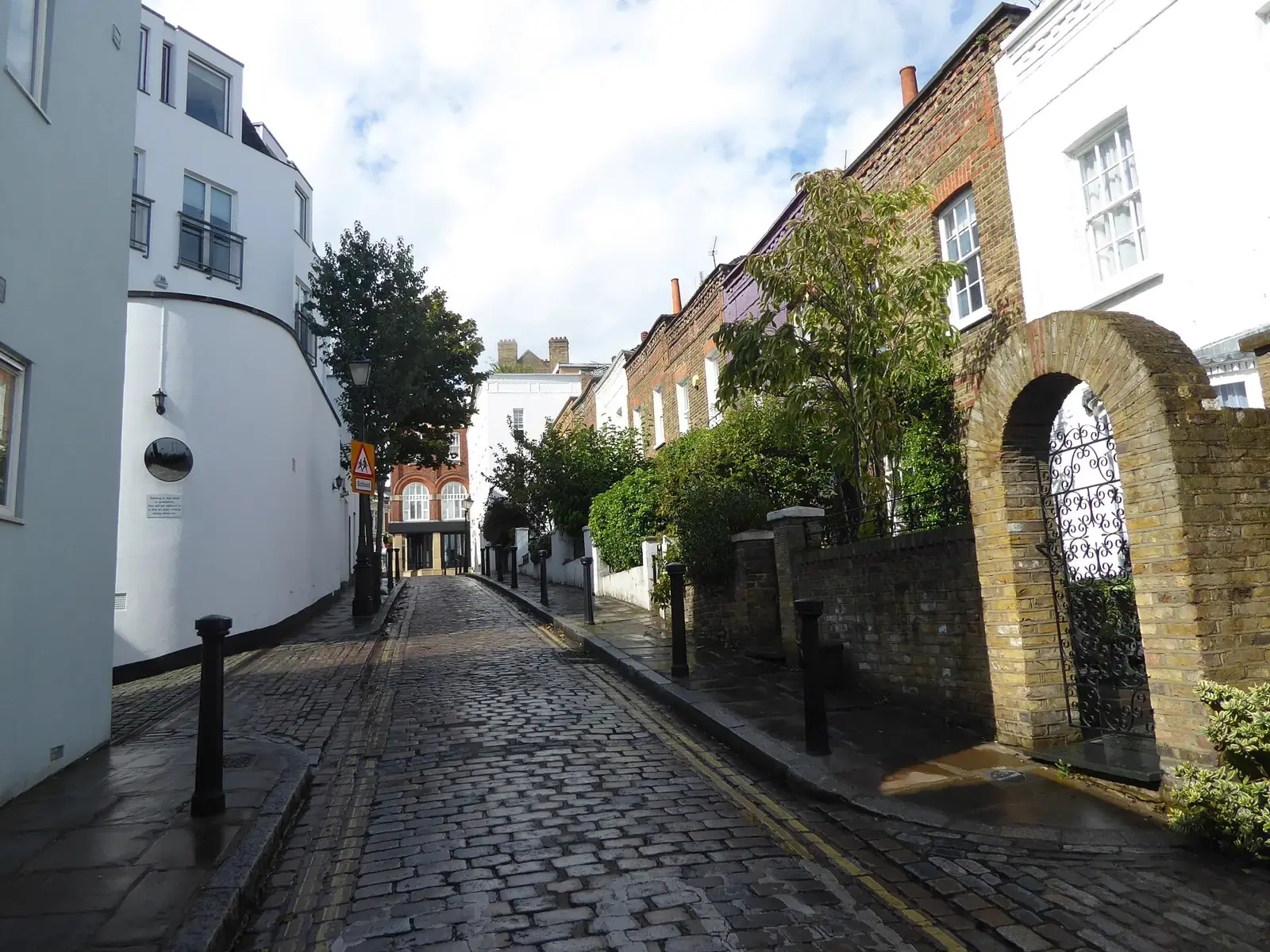
Look at the Downshire Hill stucco before anything is stripped
The first step is to name the face. Most houses on Downshire Hill carry a stucco face, and the appraisal turns to Pevsner for the point that a great deal has been kept without the street being made uniform. Preparation starts by accepting that variety. One house may have a sound coating with a few open cracks. The next may have a face that is failing in patches and sound everywhere else. Neither is an invitation to take the whole elevation back to bare for the sake of a clean start. The aim is a sound edge for the new coating, not a blank wall.
Walk the front and mark only what has failed. Hollow-sounding stucco, open cracks, and paint that has already let go are the items to deal with. Sound stucco under a sound film is left. Paths, steps and any bed at the foot of the wall are covered before washing, because the debris from even a limited cut-back will stain stone and soil. Washing is with water and a gentle cleaner suited to exterior work, not with a method that cuts into the arrises of mouldings. Downshire Hill's lack of uniformity is a reason to judge each bay on its own rather than to specify one aggressive strip for the whole street.
Decide whether the stucco is a lime face that must stay able to breathe. Where it is, the coating that goes back later has to be vapour-open. Preparation does not seal the wall with a hard stopper in every hairline crack. Cracks that are structural, as opposed to cracks in the paint, are filled with a material compatible with the stucco, brought flush, and left to cure before any finish. This note does not invent a product name. It only insists that the filler and the later coating belong to the same family of behaviour, so the wall can still lose moisture.
Preparation is only useful once the wall is sound. A facade investigation, when the failure is in the building rather than the paint, can be asked of Hampstead Chartered Surveyors, our sister surveying and building consultancy firm. Exterior coatings next door are described by Primrose Hill painters and decorators, and stucco repair beyond decoration sits with Hampstead Renovations.
Other stucco in Hampstead that needs the same reading
The church on Downshire Hill, dated 1818-23. It was built as a proprietary chapel and it is stuccoed. A chapel front of that date is not prepared like a shop fascia. Mouldings and the broad stucco planes are checked for failed paint and for cracks, and only those areas are opened up. Because the building is stuccoed as a whole, there is a lot of surface, but quantity is not a reason to burn the coating off. The date stays written as 1818-23. Preparation is still the limited cut-back described above, with the ground around the building protected and the work organised from the top of the elevation downward so that dust does not fall through finished areas.
Christchurch Hill's dressings, not a fully stuccoed wall. That front is flat, the house runs to three floors over a basement, the door is arched, stucco is used as the dressing, and the sashes at ground floor are tripartite. Preparation of the stucco is concentrated on those dressings and on the door arch. Edges against the flat wall are masked so that filler and later paint do not creep onto a surface that is not stucco. The tripartite sashes are timber and are prepared as timber, which is a later step. The basement opening, where the elevation drops below the pavement line, is protected so that debris from the dressings does not collect in it.
Villas on the Heath, and Vale Lodge. Villas on the Heath, in the Vale, are finished in stucco and carry hood moulds above the windows. Those moulds collect water and failed paint at their drips, so they are checked closely and loose material is cut back without rounding off the profile. Vale Lodge is listed, a substantial villa of two storeys from the early 19th century, stuccoed, and set in a large garden. The garden is part of the preparation plan: planting and paths are covered before any washing, and the two-storey height is still worked from the top down. Listing is a reason to repair the existing stucco rather than to replace the appearance of the villa with a different facing.
Brick that is not a painting project: Cannon Hall and guideline H19
Cannon Hall is the brick example to keep in mind. At No. 14 Cannon Place the house is a mansion of the early 18th century, with a courtyard in front, brown brick picked out by red brick dressings, and a listing at grade II*. Brown brick and red dressings are the architecture. They are not a stained or tired coating waiting to be refreshed. Guideline H19 withholds paint, render and cladding from original brickwork unless one of those was the first treatment, because the conservation area's appearance can be damaged and the result can be extremely difficult to reverse. A grade II* mansion in a courtyard is exactly the sort of front where that mistake would be public and hard to undo.
Preparation on a brick front of this kind is therefore mostly a decision not to prepare it for paint. The courtyard and the dressings are protected from whatever work is happening to the joinery. Dust from sanding wood is kept off the brick. No masonry paint is opened on the assumption that brick and joinery are one item. If some later film is found on a small area of brick, it is not used as a sample for the rest of No. 14. H19 asks whether paint, render or cladding was the original treatment. The description of Cannon Hall is brown brick with red brick dressings, so the original treatment was not a painted render.
The same refusal travels to any original brick on a Hampstead house that was never coated. Stucco houses on Downshire Hill are a different case, because the majority are already stuccoed and that stucco is what gets prepared. A brick house, or a brick dressing, is not turned into stucco in order to make the painting easier. Cladding over brick is the same error as painting it. H19 names all three. The preparation schedule should show brick as excluded, in plain words, so that nobody on the job treats a lull as a chance to coat it.
Lead in old coatings, and why heat is not a preparation tool
Old paint in Hampstead may contain lead. The HSE records that lead pigments were in wide household use up to the 1960s, so a coating from before then may still hold lead. A stucco front last decorated long before that decade, and many were, has to be handled as if lead could be present. That assumption changes the tools. It does not mean every flake is dangerous in the same way, but it does mean preparation is planned to avoid making dust and to avoid making fume.
Do not burn it off. HSE guidance will not allow leaded paint to be overheated, and it names blow lamps and gas torches as the methods to reject. That rules out the old habit of flaming a stucco pier or a window staff bead until the paint softens. Heat on leaded paint is not a shortcut around a slow scrape. It is a method the guidance rejects. Chemical strippers and heated guns are not given a brand recommendation here. The point is the negative one: blow lamps and gas torches stay off the elevation.
Only failed paint comes off. The HSE advice is to keep sound old paint where it is, and to strip back only the paint that flakes, chips or dusts. On a Downshire Hill stucco front, or on the hood moulds at Villas on the Heath, that means the sound film stays as the substrate. Edges of flaking areas are cut back to a firm boundary and feathered so the repair does not show as a ridge. Dusting paint is removed because it is already failing, not because a bare wall looks more thorough. Chipping at arrises is cut back locally. The rest is washed and kept.
Dry sanding, and how to open a failed patch without making lead dust
Dry sanding is the risk to plan out. Dry sanding of old paint is one of the tasks the HSE places among those that put people most at risk from lead dust. Rubbing a whole stucco bay with dry abrasive, or sanding a dressing back to a smooth bare face, is exactly that job. If a feathered edge needs smoothing, the method should not throw dust into the air or onto the pavement. Wet working, and collection of whatever debris does come off, belongs in the plan before the first scraper is used. This is not a claim about a particular tool brand. It is a refusal of dry sanding as the default.
What to do with the debris. Flakes from leaded paint are not swept into the garden or left in an open bucket at the gate. They are gathered, the sheets under the work are folded inward rather than shaken, and the path is cleaned so that dust is not walked into the house. People doing the work avoid eating and smoking with contaminated hands, and they wash. Those are ordinary controls once the 1960s lead warning is taken seriously. They apply on a villa in a large garden at Vale Lodge just as they apply on a terrace tight to the pavement on Christchurch Hill.
Joinery on the same front follows the same lead rules. Tripartite sashes and an arched door are not burnt off with a torch because the stucco rule was understood and the wood was treated as a different material. Lead pigments were used on joinery as well as on walls until the 1960s. Blow lamps and gas torches stay out of the window rebates. Dry sanding of old door paint is the same dust risk as dry sanding the wall. Loose, flaking, chipping or dusting paint on the wood is the part that is removed. Sound paint on a sash stays put.
Filling, priming and the coating that goes back on stucco
Once the failed paint is off, the stucco is made good. Cracks are opened only as far as needed to get a filler to hold, then filled flush with the existing face. Mouldings, including hood moulds, are filled so that the profile stays crisp rather than being blobbed smooth. The flat Christchurch Hill dressings are filled without building a new thickness that would cast a different shadow. Deep hollows in the 1818-23 church stucco are repaired as stucco, not packed with a hard cement that fights the surrounding material. Each fill is allowed to settle before it is rubbed down, and that rubbing is not a return to dry sanding of old leaded paint.
Bare timber, where a sash or a door has been taken back, gets a primer before the finish. The primer is there to seal the wood, not to build a thick coat count, and this note deliberately does not say how many films follow. Previously painted wood that is still sound is cleaned and coated without being stripped. Lime stucco receives a vapour-open finish so the wall can keep breathing. Masonry paint meant for brick is not spread onto original bare brick in order to use up a tin. Brick that H19 excludes from the specification stays excluded at this stage as well.
Work from the top of the elevation downward. On Vale Lodge that means the upper storey is completed, or at least prepared and made good, before the lower wall is finished, so that dust does not spoil it. On Christchurch Hill the dressings at the top are dealt with before the ground-floor tripartite sashes are finished. Sheets stay down until the debris of filling has been removed. Planting that was covered at the start stays covered until the washing of tools is finished away from the bed.
If a material really has to be replaced
Replacement is the last resort, and it has a matching rule. When a replacement cannot be avoided, Camden looks for materials that closely match the original, and it names concrete roof tiles, artificial slate and PVCu windows as unacceptable in the conservation area. Preparation of a stucco front sometimes reveals a rotten sash or a failed piece of dressing. The answer is not a plastic window and not a concrete tile slipped onto the roof because it was convenient. A timber window that matches the existing one, or a stucco repair that matches the existing face, is the direction the guidance points.
That rule protects the streets already described. A PVCu window in the tripartite pattern of Christchurch Hill would not closely match timber sashes. Artificial slate on a roof that was never slate of that kind fails the same test. Concrete tiles fail it too. Vale Lodge, being a listed stuccoed villa, is a poor place to discover those substitutes after the paint has been scraped. The preparation survey should note rotten timber and failed stucco as repair items in matching materials, and it should state that original brick, such as the brown brick and red dressings at Cannon Hall, No. 14 Cannon Place, is not a surface to be replaced with render or with cladding.
Putting the schedule in order. Name stucco and name original brick before a tool is opened. Paths and planting are sheeted. Older paint is treated as a possible lead risk because those pigments were common until the 1960s. Blow lamps and gas torches stay packed away. Only flaking, chipping or dusting paint is taken off. Old paint is not rubbed down dry. Cracks in the stucco are filled, bare timber is primed, and a vapour-open coating goes back on lime stucco. Cannon Hall's brick, and any other original brick, stays out of the paint under H19. If something must be replaced, it matches the original, without concrete tiles, artificial slate or PVCu windows. That is the preparation of a Hampstead front, and it is complete before anyone talks about a decorative colour.
Questions about preparing stucco and brick in Hampstead
Should all the old paint come off a Downshire Hill stucco house?
No. Most of Downshire Hill is already a stucco street, but sound old paint should stay. The HSE limit is to strip films that flake, chip or dust. Clearing an entire bay creates dust, and rubbing old paint dry is a lead-dust task the HSE ranks among the most serious. Those pigments were common until the 1960s. Take off the failed patches and keep what is still sound.
Why are blow lamps a bad idea on these fronts?
A blow lamp or a gas torch would overheat leaded paint, and HSE guidance forbids that. Household coatings often contained lead pigments until the 1960s, so the stuccoed chapel of 1818-23, a hood mould in the Vale of Health, or an old sash may all be carrying it. Burning the film off is the rejected method. Cut back what is already loose, and leave the flame out of the work.
Is the brown brick at Cannon Hall prepared for a masonry coating?
It is not. Cannon Hall at No. 14 Cannon Place is the early 18th century mansion whose front courtyard shows brown brick and red brick dressings, and the listing is grade II*. Guideline H19 leaves that original brick without paint, render or cladding unless such a finish was original. Preparation there is for the joinery, with the brick protected from dust and spills. The courtyard front stays brick.
Sources
Related reading
- Exterior painting on Downshire Hill, where the majority of houses are stuccoed
- Exterior painting for Christchurch Hill's stucco dressings and tripartite sashes
- Exterior painting at the Vale of Health, including stuccoed villas with hood moulds
- Exterior painting where lime stucco stays vapour-open and original brick is left bare
- The wider Hampstead period-homes note, read after this preparation sequence
Stucco and brick in Hampstead are quoted only once the failed paint, the bare timber and the lead risk have been seen. Ask for the stucco and brick visit.