Repainting railings and basement areas in Hampstead
How railings and basement areas are repainted in Hampstead, from cast iron on Church Row to low brick walls with piers along Downshire Hill.
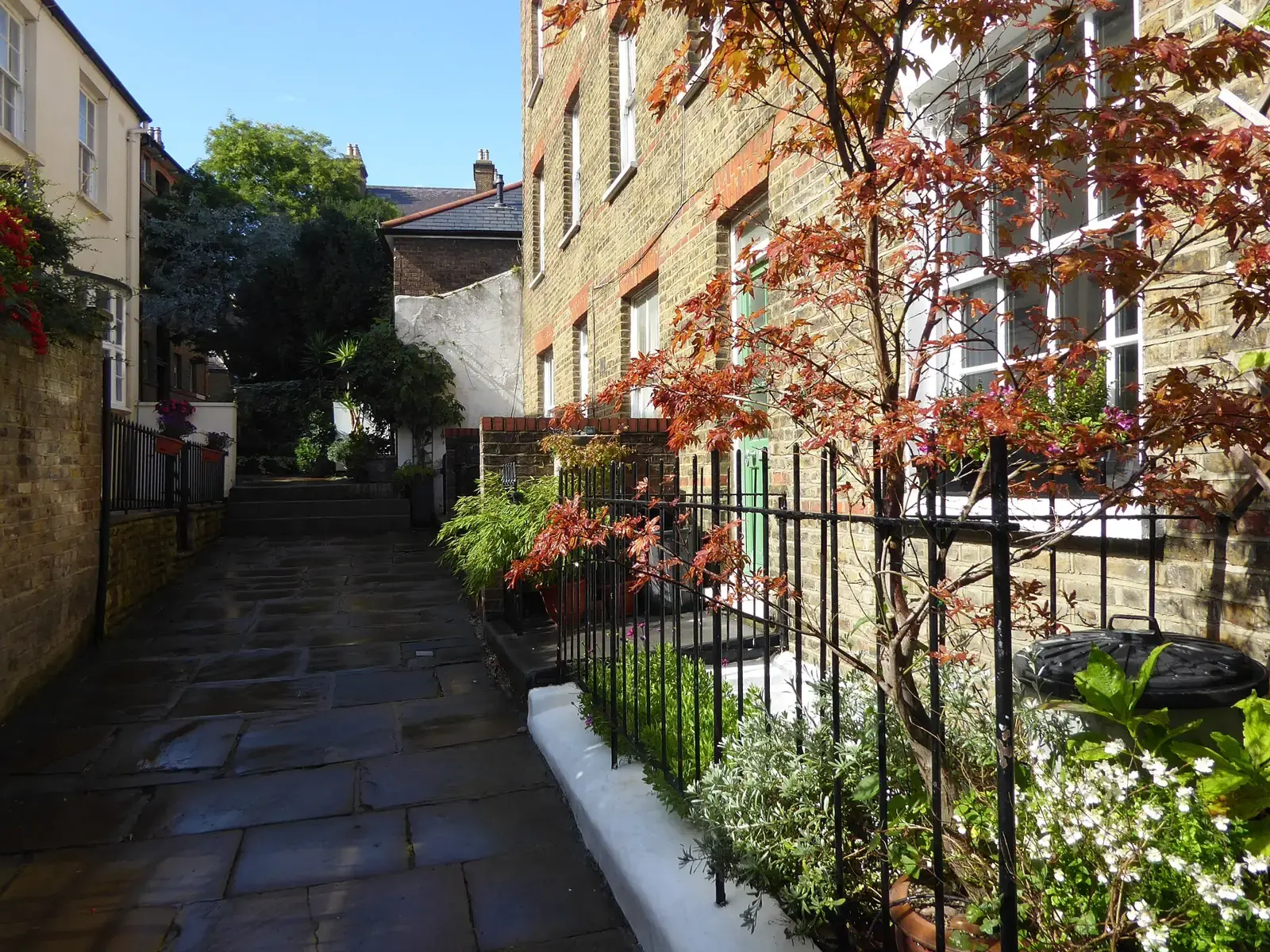
Cast iron railings along Church Row
The front edge of Church Row is often iron. Many of the houses have cast iron railings that form the front boundary, so a decorating visit that looks only at the brick and the windows has missed the thing a person touches at the pavement. Those railings are a repeating boundary, not a one-off gate. They are prepared as metal. Loose scale is taken off without grinding sound paint into dust. Bare metal is primed before any finish. The coating stays on the iron. It is not brushed onto the stone or brick plinth as if the plinth were part of the railing.
Where a basement area sits behind that iron, the area is a different trade. The wall of the area, the steps and the paving are masonry. They are brushed down and, if they were previously coated, treated as masonry. They do not receive the metal primer. Soil, leaves and standing dirt are cleared so that the paint line at the foot of each bar is honest, but the clearing is not an excuse to chip the edge of the area wall. Paths on the street side are covered, because scale and drips fall outward onto the pavement as readily as they fall inward.
Church Row's railings are also a character item, which is why they are not casually taken down to make painting the house easier. Under guideline H10, the front garden and the rear garden belong to the character of the Hampstead Conservation Area, and many of them still keep boundary walls, railings and planting. A railing that forms the front boundary is exactly that sort of feature. Painting it in place, with the bars masked off from the masonry, keeps the boundary and renews the coating. Removing it would be an alteration, and alteration is a later question, not a preparation step.
Ironwork kept off the brick is the same exterior discipline on the stucco streets south of here. See Primrose Hill painters and decorators. Replacing failed iron or rebuilding a basement area is building work and sits with Hampstead Renovations.
Downshire Hill walls, piers and a profusion of ironwork
A unified edge made of brick and iron together. Along Downshire Hill the front boundaries are linked by low brick walls, piers and railings, and that run gives the street one edge. The wall and the pier are masonry. The railing is metal. Repainting that mistakes the whole boundary for iron will leave masonry paint, or metal paint, on the wrong material. The usual split is simple. Brick that is bare stays bare of the railing coating. Iron is primed and finished on its own. Piers are protected with sheets or with careful cutting-in so that a black or dark metal finish does not speckle the brick.
Iron is not only on the boundary. On Downshire Hill the houses are sometimes two storeys and sometimes three, and ironwork is profuse both on the facades and on the front boundaries. Iron fixed to a facade, and iron standing on the boundary, are both metal even when the fixing goes back into stucco or brick. Facade iron is reached as the elevation is worked from the top downward, so that scale from an upper balcony does not fall into wet paint on a lower railing. Front-boundary iron is done with the pavement protected. The profusion means the specification has to list iron, not hide it inside a single line called exterior decoration.
Gardens behind that edge are wide. The houses stand in deep front gardens, and the edge of each garden is a low wall, a hedge or a run of railings. A hedge is not painted. A low wall is not given the metal coating. A railing in front of a deep garden still needs the path and the planting protected, because the garden is large enough to catch a lot of debris and the pavement is still public. Spaciousness does not make the iron less important. It makes the protection wider. Guideline H10 is again the reason those gardens, walls, railings and planting are treated as part of the area's character rather than as obstacles to be cut back for access.
Well Walk gates and the railings at No. 2 Hampstead Square
Cast-iron gates on low brick walls in Well Walk. The listed terrace at Nos. 32-40 is early 19th century brown brick, with porches in grey brick, and the original cast-iron railings and gates stand on low brick walls. The railings and the gates are the metal. The low walls and the grey brick porches are masonry. Original iron is kept and recoated, not replaced because the paint has failed. The brown brick of the houses and the grey brick of the porches are not the place to wipe surplus metal paint. Listed status on this terrace is a reason to repair the original gates and railings in position. The Wells Tavern is listed and dated 1849, and it holds the corner where Well Walk meets Christchurch Hill, so boundaries there are seen from more than one street and a splashed wall would be obvious.
No. 2 Hampstead Square keeps a carved hood and original railings together. At No. 2 the doorcase carries a hood that is carved and braced by console brackets, and the boundary in front is still the original cast iron railing. The hood is joinery or carved work to be decorated as wood, with bare timber primed and loose paint cut back. The railings are iron, primed as metal. They meet at the entrance, which is why the two coatings are easy to muddle. Masking along the shoe of the railing, and along the edge of the hood, stops one finish contaminating the other. Original railings are not swapped for a modern pattern because the bars look thin once the rust is removed. Thin iron is still the original boundary.
Basement areas at these entrances, where they exist, stay masonry. Not every front in this note has a deep area, and this guide does not invent one for a house that sits flush. Where an area does drop behind the railing, its walls are prepared separately from the bars. Steps are covered so that primer is not walked upward onto a porch. At Nos. 32-40 the low brick wall is the clue that the iron is a boundary on a wall, not a freestanding fence in a field. At No. 2 the railings are the front boundary in front of a hooded door. In both cases the metal finish stops at the metal.
New End, where a terrace sits hard on the pavement
A different boundary, with almost no garden in front. New End's east side has a brick terrace of three storeys set hard against the pavement. There is no spacious front garden of the Downshire Hill kind, and there is no low wall with piers holding a run of railings clear of the walking line. Paint already covers most of that terrace. Even so, the appraisal still picks out good details, and one of them is a decorative cornice in brick. Repainting railings, where any iron exists on this front, has to avoid coating that cornice with metal paint. The cornice is brick detail. It is already a noted feature on a terrace that has largely been painted, and it should not disappear under a further careless film.
Sitting hard on the pavement changes the protection, not the metallurgy. Scale and drips fall straight onto the public footway. Sheets are essential, and they have to be managed so that people can still pass. There is no front garden in which to stand a mess of flakes. Sound paint on any iron stays in place. The HSE advice is that sound old paint should stay, and that stripping should be limited to paint which is flaking, chipping or dusting. On a terrace this close to passers-by, turning sound paint into dust would be both the wrong preparation and a nuisance on the pavement. Flaking and chipping are cut back to a firm edge. Dusting paint is removed because it has already failed.
The painted brick is not a pattern for the railings method. Most of the New End terrace has been painted, which is a statement about the wall, not an instruction to paint every remaining bare detail or to treat the cornice as joinery. Metal primer does not go onto brick, painted or not, merely because the brush is open. If iron is fixed to that painted wall, the iron is masked and finished alone. The decorative brick cornice is kept readable. This east-side terrace is in the note because its boundary condition is the opposite of Church Row and Downshire Hill: no set-back, little or no area in front, and a wall that meets the pavement.
Guidelines H10 and the harm in altering boundaries
Gardens and their edges are character, not spare land. Guideline H10 puts front and rear gardens inside the character of the Hampstead Conservation Area and notes that many still have boundary walls, railings and planting. Repainting is one way to keep the iron part of that character in good condition. It is not a pretext for widening an opening, lowering a pier, or replacing a cast pattern with a plain bar. Planting is protected rather than cut away to give a clearer run at the railings. Where a hedge shares the boundary with a low wall, as on Downshire Hill, the hedge is sheeted so that paint does not speckle the leaves.
Camden's warning is that a change to the walls and railings which stand between pavement and house can harm conservation-area character, since those boundaries are what set the buildings off. That warning covers Church Row's cast iron, Downshire Hill's low walls with piers and railings, the gates on low brick walls at Nos. 32-40 Well Walk, and the original railings in front of the hood at No. 2 Hampstead Square. A basement area is part of the same setting-off. Changing the railing that guards it, or rendering the area wall so that it no longer reads as the original boundary, is the harm the warning describes. Recoating iron that is already painted is maintenance. Rebuilding the boundary is not.
What a specification can say without becoming an alteration. It can list the railings, the gates, the facade iron and, where present, the metal guard to a basement area. It can exclude bare brick walls, grey brick porches, decorative brick cornices and hedges. It can require priming of bare metal and a finish kept off the masonry. It should not propose removal of original railings merely to make the paint job neater. H10 and the warning about boundaries are the reasons those exclusions are written down before work starts.
Lead on old railings, and a sequence that leaves sound paint alone
Railings of any age in this area may carry lead. Until the 1960s, the HSE records, lead pigments were widely used in paints for the house, so older paintwork on iron may contain lead. Cast iron on Church Row, gates on Well Walk and the original railings at No. 2 Hampstead Square are old enough that their coatings have to be treated with that in mind. The practical result matches the stripping rule. Sound paint stays. Only paint that is flaking, chipping or dusting is taken off. Leaving the sound film also means the job does not turn a firm coating into dust on the pavement or into a basement area.
Loose scale is not the same as a sound film. Scale that has lifted, and rust that is laminated and loose, is removed until what remains is attached. The removal stops there. Wire-brushing a sound length of paint down to bright metal creates the dust the lead warning makes unwise, and it throws away a substrate that was still protecting the iron. After the loose material is gone, bare metal is primed before the finish. Primer on iron is not primer on the brick pier behind it. The brush is kept on the bar, and the pier, the plinth and the area wall are shielded.
Order for a Hampstead railing and its area. Cover the pavement, the steps and any planting. Identify iron versus masonry, including low brick walls, piers, grey porches and the New End cornice. Remove loose scale and flaking, chipping or dusting paint, and leave sound paint. Prime bare metal. Finish the metal without coating the wall behind it as though it were iron. Work facade iron from the top of the house downward so that upper balconies do not shed dirt onto finished bars. Do not alter the walls and railings that set the houses off. Do not treat a hedge as a surface. Where a basement area exists, decorate its masonry as masonry and its guard as metal. That sequence is general practice, tied to streets whose boundaries the appraisal actually describes.
Questions about railings and basement areas in Hampstead
Are Church Row's railings part of the painting, or only the brick?
The railings are part of the job. Plenty of Church Row houses take their front boundary from cast iron railings. They are cleaned of loose scale, primed where the metal is bare, and finished as iron. The masonry beside them is not coated with the metal paint. Guideline H10 treats boundary railings as part of the conservation area's character, so the work renews the coating without taking the boundary away.
What should happen to the gates in front of Nos. 32-40 Well Walk?
They should be kept and recoated, not redesigned. That listed early 19th century terrace of brown-brick houses has grey brick porches and original cast-iron railings and gates on low brick walls. The iron is metalwork. The low walls and the grey porches are masonry and do not take the railing finish. Altering those walls and railings would risk the harm Camden describes, because boundaries of this kind set the buildings off from the pavement.
Does old railing paint need to be stripped back to bare metal?
Not where it is still sound. Lead pigments were widely used until the 1960s, so older railing paint may contain lead, and sound old paint is best left in place. Strip back only what is flaking, chipping or dusting. Loose rust scale comes off, then bare metal is primed before the finish. Brushing a sound coating into dust is the wrong kind of thoroughness, especially over a pavement or a basement area.
Sources
Related reading
- Exterior painting on Church Row, where cast iron railings form many of the front boundaries
- Exterior painting on Downshire Hill, with low brick walls, piers and a profusion of ironwork
- Well Walk, including original cast-iron gates on low brick walls at Nos. 32-40
- Exterior painting that finishes iron separately from the masonry behind it
- Preparing stucco and brick so that metal coatings are not spread onto the wall
Railings in Hampstead are quoted only after the iron, the brick plinth and any basement area have been seen apart from each other. Request the railings visit.