Caring for and repainting timber sash windows in Hampstead
How to care for and repaint timber sash windows in Hampstead, including the tripartite ground-floor sashes on the flat Christchurch Hill front.
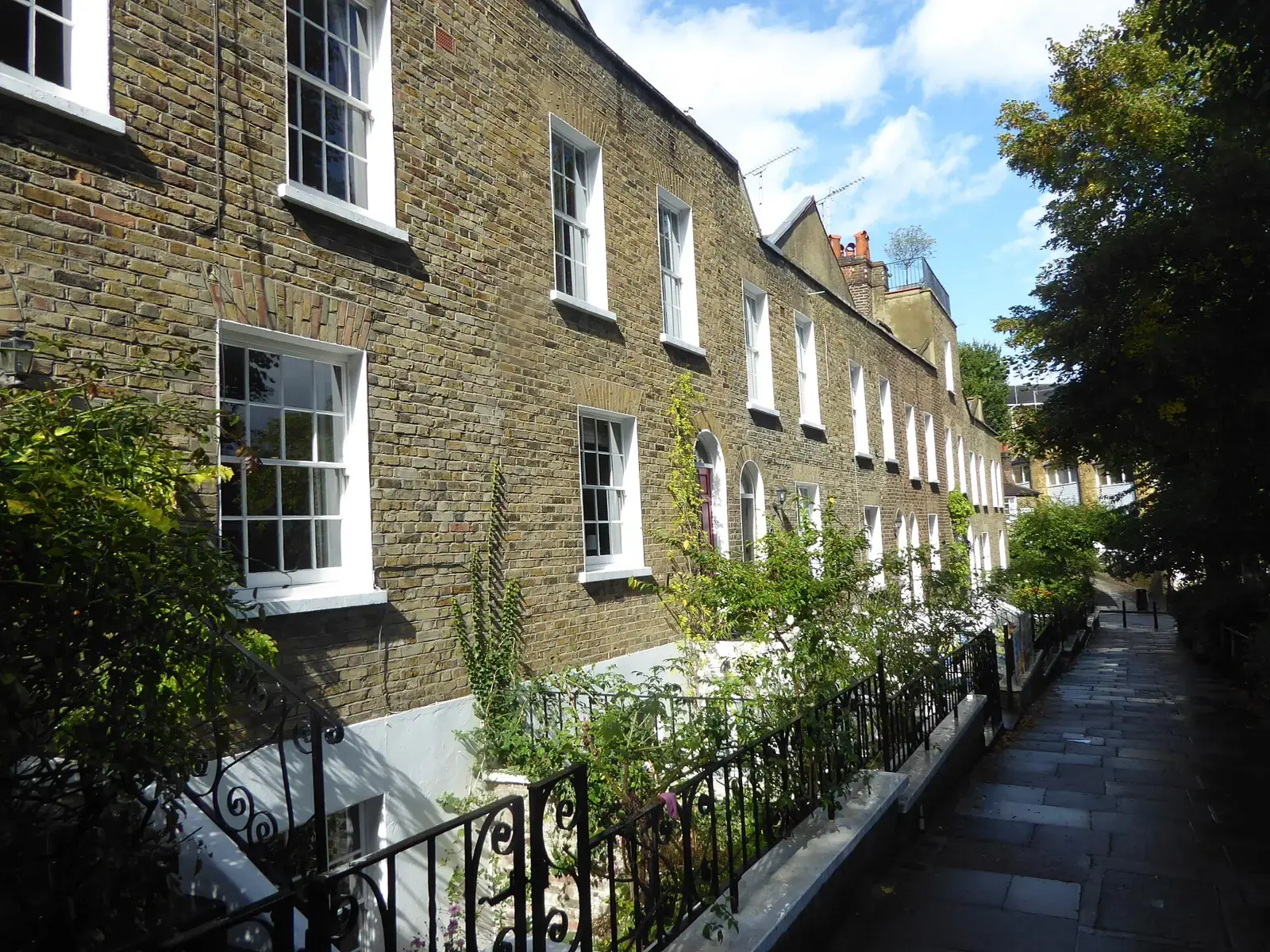
The Hampstead Square terrace that hides most of its glass
A street front with almost no windows to paint. One terrace on Hampstead Square offers the road just two front doors and one small window. The remaining glazing turns onto the south elevation and the east elevation. Anyone planning sash work from a glance up the street will miss nearly all of it. The small street window still matters, because it is the one a passer-by sees, but the real quantity of timber, putty and cord is on the returns. Access, protection of paths on those sides, and the order of work all follow the glass, not the front door.
Those south and east sashes are still original features worth keeping. Guideline H17 asks that original features which characterise the conservation area be kept in good repair, and replaced only if there is no alternative or if the replacement would enhance the building. A sash that sticks, or a meeting rail that has lost its paint, is a repair. It is not, by itself, proof that there is no alternative to a new window. The terrace's odd plan, with so little glass toward the street, is part of its character. Replacing the hidden sashes with something flatter and blanker would throw away the feature H17 is written to retain.
Practical access on that plan. Because the windows turn the corner, sheets are needed on more than one path, and any planting on the south or east side is covered before a sash is eased. Interior floors under the openings are protected as well, since a sash that is pulled inward for repair will drop dust into the room. The single small window on the street is dealt with as carefully as the larger ones, not dismissed because it is small. Work still runs from the higher windows downward so that scrapings do not land in wet paint below.
Easing, priming bare timber and recoating a sash is joinery decoration. Primrose Hill painters and decorators and St John's Wood painters and decorators treat that trade on their own streets. A decayed frame that has to be rebuilt sits with Hampstead Renovations.
Tripartite sashes and stucco dressings on Christchurch Hill
Ground-floor windows that are three lights wide. On the Christchurch Hill terrace the ground-floor sashes are tripartite, set in a flat front that also has an arched entrance, stucco dressings, three floors and a basement. The wide ground-floor lights are the ones people notice, and they are timber. Preparation starts by easing each sash so that it will travel, because a window painted shut is a window that will tear its new coating the first time it is forced. Cords, weights and the staff beads are respected rather than cut away to make the painting faster.
Stucco dressings sit beside the timber, and they are not the same task. The dressings are masonry modelled around the openings. They get their own cleaning and, where they are already coated, their own renewal. Paint from the sash must not be brushed across the dressing in one careless stroke, and filler from the dressing must not be smeared onto the cill. The flatness of the terrace makes a ragged edge obvious. Masking, or a very steady cut-in, keeps the tripartite frame reading as joinery and the surround reading as stucco.
The arched door is joinery too, but it is not a sash. It is mentioned here only so that the opening beside it is not forgotten when the ground floor is scheduled. The door, its arch and the tripartite windows share a storey. They do not share a method. A door can be wedged and painted in position more often than a sash, which usually needs to be eased, parted from a stuck bead, and painted along the edges that only show when it is open. Basement joinery, where the terrace drops to a lower level, is included in the same logic: timber is primed where it is bare, and it is not swapped for a different material because the light is poor.
Keystones on Christchurch Hill, and the dormers at Nos. 5 and 11
A decorative keystone is masonry, even when it sits over a painted frame. A decorative keystone marks the lintels and the doorways along that Christchurch Hill terrace. When the sash or the door is repainted, the keystone is masked so that the joinery colour does not climb onto it unless the keystone itself was already a painted element of the same scheme. Scraping up to the keystone is done so that the modelled edge is not rounded off. The keystone is one of the features that makes the terrace consistent. Guideline H17 is the reason to keep it, and to repair rather than to knock it off as an inconvenience to the paint line.
Dormers that already harm the terrace should not be copied. At Nos. 5 and 11 the appraisal finds the dormers over-large, and says they harm how consistent the Christchurch Hill terrace looks. Repainting does not mean enlarging any other roof window to match those two, and it does not mean treating the oversized dormers as the pattern for new joinery. If the dormers at Nos. 5 and 11 have timber that needs maintenance, that timber can be eased, prepared and coated. The harm the appraisal names is the size, not the fact that wood needs paint. Paint will not repair an over-large dormer, and more timber of the same bulk would make the inconsistency worse.
Replacement only in the cases H17 allows. Original sashes, keystones and the ordinary roof windows that do not share that over-large form are kept in good repair. Replacement waits until there is no alternative, or until the replacement would enhance the building. A new dormer as big as those at Nos. 5 and 11 would not enhance the terrace. The appraisal has already said that bulk harms consistency. Enhancing, in this setting, means a window that fits the flat front and the rhythm of the sashes, not a larger hole in the roof.
Easing the sashes and dealing with loose putty
Free the window before you decorate it. A sash that has been painted into its runners is eased with care so that the box and the beads survive. Beads that have to come off are labelled and put back, because they are part of the original window H17 is concerned to keep. Cords that are sound are left. The meeting rails and the bottom rail are the usual places where paint has built up enough to jam the movement. Cutting that build-up back is general joinery practice. It is not an excuse to scrap the sash.
Loose putty is cut out and the rebate is made ready for new putty once the glass is secure. Putty that is still doing its job stays. Dry, cracked putty that has left the glass is the part that is replaced, because water is already getting at the timber. The new putty is tooled to a line that sheds rain, and it is not painted until it has skinned enough to take a coating. This note gives no number of days for that wait and no temperature. It only says the putty has to be ready, and that painting too soon pulls the putty out of shape. Glazing sprigs or the existing fixing are left undisturbed if they are sound.
Bare timber gets a primer. Where the arris or the cill has worn back to wood, that wood is primed before a finish is applied. The primer is the layer that stops the later coating sinking into the grain and failing early. Sound paint on the rest of the sash is washed and keyed only as far as general practice requires, without a campaign to strip the whole window. The coating that follows should stay able to breathe, so moisture that gets into an old sash can still leave it. A film that seals every face of an historic timber section is a common way to trap decay behind a shiny rail.
Lead paint on Hampstead joinery: heat and dry sanding
Assume lead until the age of the paint says otherwise. Lead pigments, the HSE notes, were widely used for household paint until the 1960s, which is why older sash paint may contain lead. Sashes on an early terrace, and many later ones that have simply never been stripped, fall inside that warning. The south and east windows on the Hampstead Square terrace, and the tripartite lights on Christchurch Hill, are repainted with that possibility in mind. The warning changes the tools. It does not forbid repainting.
No blow lamp and no gas torch in the rebate. HSE guidance rules out overheating leaded paint by means of blow lamps or gas torches. Burning paint off a staff bead or a meeting rail is the habit to drop. Heat that drives lead fume off the wood is not preparation. It is the method the guidance names as unacceptable. Scraping loose material, and priming the bare patches, replaces the flame. The same ban applies to the small street window as to a wide tripartite sash. Size does not make a torch safer.
Dry sanding is how lead dust is made. On the HSE list of jobs that put people most at risk from lead dust, dry sanding of old paint is one of the entries. Flattening a sash with dry abrasive, especially inside a room on the south or east side, fills the air and the floor with that dust. If an edge needs to be eased smooth, it is not done as open dry sanding of the old coating. Sheets stay on the floor and on the path, and debris is folded away rather than shaken out. People wash before they eat. None of this is a brand of paint. It is the control that follows from the 1960s lead note and from the dry-sanding warning together.
Why the repair is not a plastic window
PVCu is named as unacceptable. If replacement truly cannot be avoided, Camden wants materials that closely match the original, and it would not accept concrete roof tiles, artificial slate or PVCu windows in the conservation area. A stuck sash on Christchurch Hill, or a tired small window on the Hampstead Square terrace, is not unavoidable replacement. It is a candidate for easing, putty repair and repainting. Even if a sash were past repair, the matching material would be timber of the same pattern, not PVCu. Concrete tiles and artificial slate are the same guidance speaking about roofs, and they are recorded here so the window rule is not quoted out of its sentence.
H17 and the materials rule point the same way. Keep the original feature in good repair. Replace it only when there is no alternative, or when replacement would enhance the building. A plastic window does not closely match a timber sash, so it fails the materials test, and it does not enhance a terrace whose character includes tripartite ground-floor sashes, decorative keystones, and a Hampstead Square front that shows almost no glass to the street. Enhancement would be a sound timber sash in the existing opening. The over-large dormers at Nos. 5 and 11 are a warning about the wrong kind of change, not a precedent for further alteration.
Order of work, gathered in one place. Identify which windows are actually on the job, including the south and east sashes that the Hampstead Square street front conceals, and the tripartite lights, the arched door joinery and any dormer timber on Christchurch Hill. Ease each sash and cut out putty that has failed. Prime any timber that is bare, and keep the coating able to breathe. Old paint is not overheated with a blow lamp or a gas torch, and it is not sanded dry. Mask keystones and stucco dressings so the joinery colour stays on the joinery. Do not recommend a PVCu substitute. Do not enlarge dormers toward the bulk already criticised at Nos. 5 and 11. Protect floors, cills, paths and planting, and work from the top of the house downward. That is the care of a timber sash in this conservation area.
Questions about sash windows in Hampstead
Why does the Hampstead Square street front understate the sash work?
The street elevation of that Hampstead Square terrace is almost blank, with two doors and one small window and nothing else glazed. The rest of the windows face south or east. A look from the road sees almost none of the timber. Guideline H17 still wants those sashes repaired and kept. A new window waits for the case where nothing else will serve, or where the new work would actually improve the house. The hidden windows are the job.
What is wrong with copying the dormers at Nos. 5 and 11?
Their bulk is what the appraisal objects to. It finds that those dormers harm how consistent the Christchurch Hill terrace remains. Repainting the timber on them is maintenance. Building more dormers of that size would spread the harm. The features to keep are the original sashes and the decorative keystones over the lintels and doorways. H17 allows a replacement only if nothing else will serve, or if the change would improve the house, and an over-large dormer does not.
Can old sash paint be burnt or dry-sanded?
Neither flame nor dry abrasive is the right approach. Household paint carried lead pigments until the 1960s, so an old sash may still hold lead. The HSE does not accept a blow lamp or a gas torch as a way to heat that paint, and it treats dry sanding of old paint as a serious lead-dust risk. Loose paint and failed putty are dealt with by other means, and timber that has gone bare is primed.
Sources
Related reading
- Sash window restoration on Christchurch Hill, where ground-floor lights are tripartite and keystones mark the lintels
- Hampstead Square, including the terrace whose other windows face south and east
- Sash window restoration that keeps timber and refuses PVCu in the conservation area
- How stucco dressings beside a sash are prepared without coating original brick
A Hampstead sash is quoted only after the stuck points, the putty and the face of the timber have been looked at. Arrange a sash-window look.